
Welcome back to Alabama Biomanufacturing Labs’ newsletter, our way of sharing the innovations coming out of our cohort and the broader biomanufacturing industry. ABL was established through a competitive award from Innovate Alabama’s tax credit program. The $1.2m program drives innovation and economic growth in the state through the work of three core partners: Opportunity Alabama, Measured Capital, and Arrowpoint Labs.
We are expanding biomanufacturing in rural areas by supporting emerging startups with technical, entrepreneurial, commercial, legal, and regulatory services from key program stakeholders. We are currently supporting a cohort of nine companies, representing Alabama ecosystems like Opelika, Auburn, Tuskegee, Troy, and Dothan, and one of them, Tuscaloosa based Hypogenica, is tackling decarbonization from an unexpected direction: caves.
A Small Ingredient With an Outsized Footprint
Precipitated calcium carbonate (PCC) rarely gets much attention, but it is everywhere. It is in the paint on your walls, the plastic in your car, the paper in your notebook, and the concrete under your feet.1 Producing it under standard methods is incredibly energy and emission-intensive. The process requires heating limestone to temperatures exceeding 1,000 °C, followed by hydration and carbonation. Manufacturing PCC emits approximately 0.6–0.9 tons of CO2 per ton of PCC produced,2 with 50.85 millions tons of PCC are produced globally each year.3 Scaled across the industry, this adds an estimated 30-45 million tons of CO2 into the atmosphere, comparable to putting 6-10 million more cars on the road4 or running 5-8 coal power plants nonstop for a year.5
Conventional PCC production is geographically restricted to the sites of carbonate deposits. This represents a significant supply chain weakness and brings product inconsistencies with variations in the raw material. This supply chain instability was highlighted by the COVID-19 pandemic and the 2021 Texas storm, both of which created significant interruptions in manufacturing pipelines.
Hypogenica Takes Its Cue From Cave Formations
Within caves across the world, bacteria with special adaptations to the cave environment are dissolving and reprecipitating carbonate minerals, a process known as biomineralization. This is the natural process that slowly forms a variety of speleothems and contributes to the formation of stalactites and stalagmites. Hypogenica’s academic partners discovered that this metabolic process precipitates tiny particles of calcium carbonate. Hypogenica patented a process that replicates this novel metabolic process inside bioreactors to produce what the company calls microbially precipitated calcium carbonate, or mPCC, positioned as a drop-in replacement for conventional calcium carbonate, with a focus on paints and coatings.
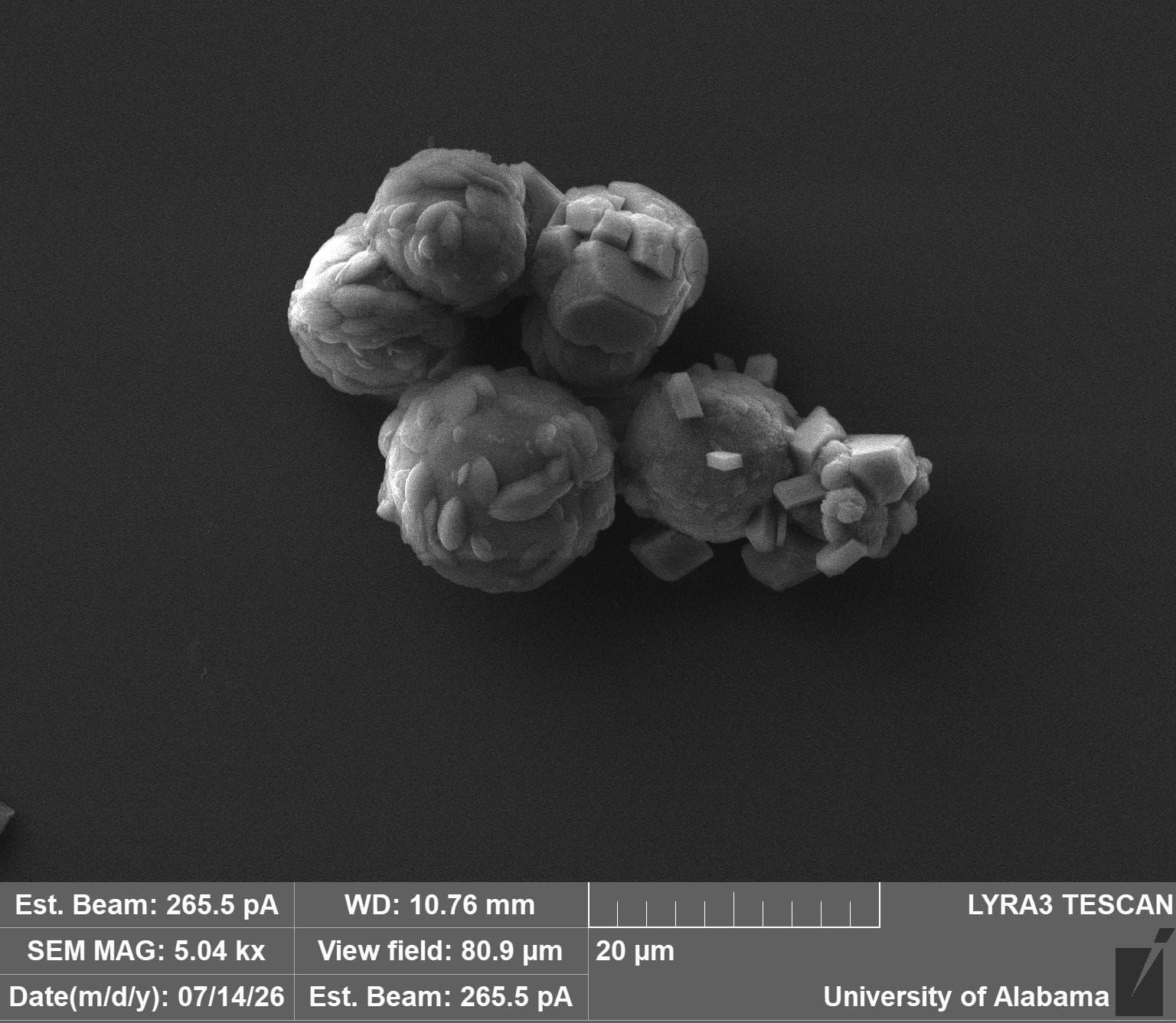
A recent sample of Hypogenica’s microbially precipitated calcium carbonate was extracted from a 3-day bioreactor culture and examined using a scanning electron microscope (SEM). The resulting high-resolution image below (Figure 1) revealed vaterite structures with calcite growth. Vaterite is a metastable phase of calcium carbonate. It gradually transforms to calcite, the mineral’s most thermodynamically stable form. Mature calcite PCCs can be used in paints and coatings, while the vaterite has applications in high-value, low-volume beachhead markets.
Hypogenica sits at the intersection of microbiology, geology, and materials science, with research roots at the University of Alabama and the University of Akron. The team is led by founder and CEO Reilly Blackwell, research lead George Breley, and CTO Dr. Hazel Barton, a well known cave microbiologist whose research anchors the company’s biomineralization approach. The global calcium carbonate market Hypogenica is entering is a sizable one, estimated at roughly $13 billion annually with a 49% CAGR, of which the precipitated calcium carbonate segment accounts for $2.36 billion, alongside an emergent nano-PCC market in pharmaceuticals and environmental remediation.2
Hypogenica is gaining momentum. In 2024, it won first prize and $5,000 at the University of Alabama’s Culverhouse Faculty and Staff Competition for its work on carbon negative CaCO3 production. In July 2025, it received an NSF STTR Phase I Award to advance mPCC as a paint filler. And in December 2025, it was selected for the sixth HudsonAlpha and gener8tor AgTech Accelerator cohort, focused on carbon capture through industrial biomaterials.
Why This Matters Beyond Alabama
Hypogenica’s work is a reminder that decarbonization does not always come from flashy new technology. Sometimes it comes from looking closely at a process nature has already perfected, in this case, underground, in the dark, over millions of years, and scaling it to run it at industrial speed. Hypogenica’s mPCC can be a genuine drop-in replacement for a material used across nearly every manufacturing sector and the impact extends well past any single product line. It serves as a template for manufacturing legacy industrial materials in a lower carbon economy, with Alabama’s caves, universities, and biomanufacturing infrastructure at the foundation.
About Alabama Biomanufacturing Labs
Alabama Biomanufacturing Labs supports startups via technical, entrepreneurial, and infrastructure support. ABL offers hands-on support to help Alabama biomanufacturing companies grow, including sponsored research support, business mentoring, legal and regulatory support, physical infrastructure planning, and opportunities to connect with partners and investors.
To learn more about this year’s ABL cohort, visit alabamabiolabs.org or follow ABL on LinkedIn.
Download the PDF (opens in a new tab)References
- 1.Grand View Research, “Calcium Carbonate Market Size, Share & Growth Report,” 2025.
- 2.Blackwell, R. S., “Scaling the Production of Microbially Precipitated Calcium Carbonate as a Carbon-Negative Filler,” proposal submitted by Hypogenica to Arrowpoint Labs for the Alabama Biomanufacturing Labs program, January 2026.
- 3.“Precipitated Calcium Carbonate Market Volume to Reach 63.40 Million Tons by 2030, Says Mordor Intelligence.” PR Newswire, Cision PR Newswire, 29 Aug. 2025
- 4.“Greenhouse Gas Emissions from a Typical Passenger Vehicle.” EPA, Environmental Protection Agency, 3 June 2026
- 5.Filonchyk, et. al., “Global greenhouse gas emissions from coal-fired power plants”, Resources, Conservation and Recycling, Volume 228, 2026, 108808, ISSN 0921-3449, https://doi.org/10.1016/j.resconrec.2026.108808.