
July 2025 Recap Newsletter · An Innovate Alabama Tax Credit Program
Abdullah Alucozai, Luke Brazinski·3 min read
Biopesticides are the future and Alabama is leading the way
Welcome to Alabama Biomanufacturing Labs’ inaugural newsletter! This newsletter is a way for our organization to share key innovations in the biomanufacturing industry and highlight companies in our cohort that are driving those trends. ABL was established through a competitive award from Innovate Alabama’s tax credit program. The $1.2m program drives innovation and economic growth in the state through the work of three core partners:



We are expanding biomanufacturing in rural areas by supporting emerging startups with technical, entrepreneurial, commercial, legal, and regulatory services from key program stakeholders. We are currently supporting a cohort of nine companies, representing Alabama ecosystems like Opelika, Auburn, Tuskegee, Troy, and Dothan.
A major study published in May uncovered a shocking connection: people who live near golf courses may have a higher risk of developing Parkinson’s disease. The suspected culprit? Synthetic pesticides, specifically used to maintain turf, are contaminating drinking water.1 This finding is part of an accumulating amount of evidence that is raising alarm regarding the health and environmental impacts of conventional pest control. And it is not exclusive to golf courses. Farmers across the United States need to strike a difficult balance when it comes to managing pests: they must effectively control the pests to protect their crops while also meeting consumer demands for crops grown without toxic synthetic pesticides. Biopesticides have shown the ability to address both of these challenges. Derived from natural materials such as animals, plants, and bacteria, biopesticides are biodegradable and can target specific pests, reducing harm to other organisms and the environment.2 This industry is expanding rapidly across the United States due to the growing market demand for sustainable agriculture.
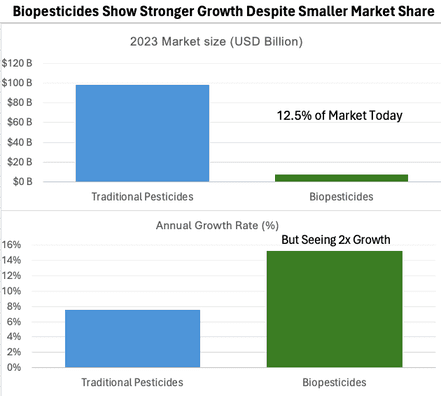
The global biopesticides market is estimated at USD 7.72 billion in 2024 and is projected to reach USD 15.66 billion by 2029, at a CAGR of 15.2% during the forecast period.3 Despite this growth, synthetic pesticides still dominate the market. In 2023, global pesticide sales totaled roughly $98.4 billion, while biopesticides accounted for just $6.7 billion, meaning microbial biopesticides represent less than 10% of the overall pesticide market.4
How RNA and peptides are shaping the future of farming
Farmers across the United States are rapidly adopting biopesticides, and Alabama is at the forefront of biopesticide innovation and testing. Many farmers today are struggling with pests and diseases that can devastate entire fields. Microscopic worms called nematodes are a major threat to the cotton grown in Alabama, since they live in the soil and feed on cotton roots. This can be seen by the 6.7% yearly yield decline, which translates to around $20.5 million in losses.5This is a problem, as farming has always been an integral part of Alabama’s economy. Biopesticides offer a solution to crop losses without causing environmental harm with toxic chemicals.
The same science that is transforming medicine is now taking root in agriculture. RNA and peptide based technologies are renowned for their contribution to vaccines and cancer therapies. By using RNA and peptides, farmers can control pests more precisely. These technologies are designed to target pests like corn earworms (Helicoverpa zea) and fall armyworms (Spodoptera frugiperda), which continue to cause problems for important crops like corn, cotton, and soybeans.6 Alabama is well-positioned to take the lead in this space with support from:
- Alabama Biomanufacturing Labs
- HudsonAlpha Wiregrass Innovation Center
- Research institutions like Tuskegee University and Auburn University7
Psigryph’s pioneering work unlocks the power of cherries
Two companies from this year’s ABL cohort are pioneering biopesticide technologies that could transform the farming industry. One of those companies, Psigryph, is developing new ways to protect crops by using a novel cellular delivery system using nanoparticles derived from Montmorency cherries. The company was founded in 2018 by CEO Sean Thompson, who brings 18 years of experience from the pharmaceutical and biopharma industry. The company initially focused on pharmaceuticals before transitioning to agriculture through the HudsonAlpha AgTech accelerator.

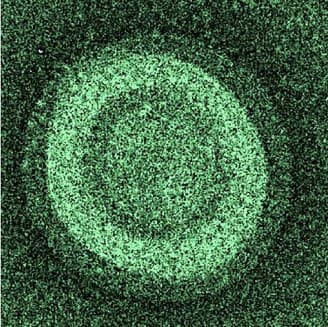
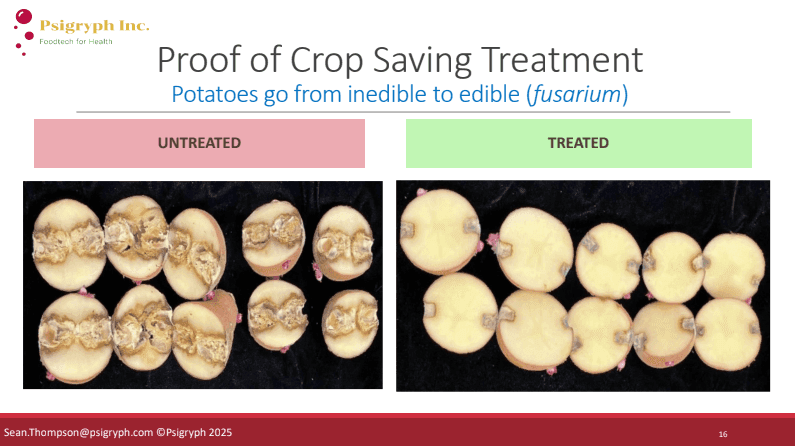
You might know Montmorency sour cherries as a tart addition to desserts, but Psigryph is turning them into a tool for revolutionizing agriculture. Its leading technology, Nanopect™, is a carbohydrate-based nanocarrier created for intracellular delivery of biological agents like RNA. It is powered by compounds extracted from Montmorency sour cherries grown in the province of Ontario and the Great Lakes states. Nanopect™ has a unique ability to deliver bioactive molecules to living cells. Compared to lipid nanoparticles (LNPs) and metal nanoparticles, Nanopect™ has numerous benefits: it is biodegradable, nontoxic, temperature/shelf stable (2 years), and able to deliver larger payloads. An image below shows its impact in action, reviving damaged potatoes. Additionally, they are also exploring a coffee cherry alternative, which they recently filed a patent for, as it has a higher pectin concentration. Similar to the evolution of the pharma industry, where chemical-based drugs were the standard before biological options arose, Sean Thompson predicts the same will happen in agriculture. He believes the industry will switch from its current ratio of approximately 90% chemical and 10% biological to a future where biologicals will be the default within the next 10 to 20 years.
Could viruses that infect bacteria revolutionize pest control?
Alabama Biomanufacturing Labs participant BioHeal is led by three professors from Tuskegee University. This team is taking a different approach to pest control by utilizing the natural enemies of bacteria. They use tools such as antimicrobial peptides derived from viruses. They can mimic the mechanisms by which certain viruses infect and disable harmful microbes. However, their focus goes beyond just managing pests. Their peptides can be used medically, acting as an antimicrobial spray for wound healing and treatment. Dr. Jesse Jaynes, a biochemist who conceived the idea 30 years ago, restarted the work upon meeting Dr. Deepa Bedi and Dr. Gregory Bernard at Tuskegee University.
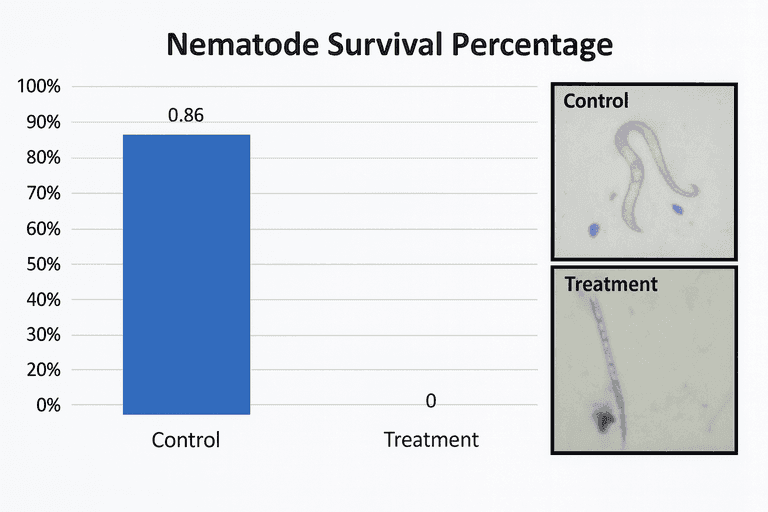
Bacteriophages, also known as phages, are viruses that specifically target and eliminate bacteria. Once attached to the bacterial cell, they inject material that can disable or destroy it. This makes them valuable natural tools for controlling bacterial diseases in agriculture.8 By utilizing a proprietary bacteriophage system, they can generate peptides that target fungi, bacteria, nematodes, and other pests. For example, the graph below shows how treatment with these peptides reduced nematode survival to 0% compared to 86% in the control group. These products are advantageous compared to others on the market due to their environmental friendliness and specificity.
The team is currently focusing on valuable produce such as tomatoes and strawberries. These crops are heavily impacted by shortages caused by pests, resulting in heavy economic losses.
- In Benin, West Africa, pests such as African bollworm (Helicoverpa armigera) and tomato leafminer (Tuta absoluta) can reduce tomato yields by up to 78%.9
- Similarly, in California, the western tarnished plant bug (Lygus hesperus) damages strawberries and leads to around $40 million in losses annually.10
BioHeal expects the biopesticide market to grow significantly over the next 10 to 20 years, mirroring the trends in the pharma industry, echoing Sean Thompson’s claims. BioHeal and Psigryph are actively making this shift towards biopesticides a reality, ensuring crops are protected with minimal environmental and human toxicities. With the contributions of ABL and other ecosystem stakeholders, Alabama is positioning itself as the nexus for biopesticide innovation.
About Alabama Biomanufacturing Labs
Alabama Biomanufacturing Labs supports startups via technical, entrepreneurial, and infrastructure support. ABL offers hands-on support to help Alabama biomanufacturing companies grow. We provide:
- Sponsored research support
- Business mentoring
- Legal and regulatory support
- Physical infrastructure planning
- Opportunities to connect with partners and investors
If you want to learn more about this year’s ABL cohort, you can check out the complete list here.
Download the PDF (opens in a new tab)References
- 1.American Parkinson’s Disease Association, “Golf Course Concerns: New Research Shows Link to Parkinson’s,” May 19, 2025. www.apdaparkinson.org
- 2.U.S. Environmental Protection Agency, “What are Biopesticides?,” October 16, 2024. www.epa.gov
- 3.MarketsandMarkets, “Biopesticides Market worth $15.66 billion by 2029,” October 2, 2024. www.marketsandmarkets.com
- 4.Environmental and Public Health Concerns of Pesticides Used on Fruits and Vegetables, Environmental Health, 2024. ehjournal.biomedcentral.com
- 5.Alabama Cooperative Extension System, “Nematodes in Alabama Cotton,” June 25, 2025. www.aces.edu
- 6.LSU, “Development and Evaluation of RNAi Based Approach for Management of Fall Armyworm, Spodoptera frugiperda,” June 23, 2024. repository.lsu.edu
- 7.Alabama Cooperative Extension System, “Ag in Alabama: Opportunities & Challenges for Economic Development,” April 2025. www.aces.edu
- 8.National Library of Medicine (NLM), “Framing the Future with Bacteriophages in Agriculture,” April 25, 2018. pmc.ncbi.nlm.nih.gov
- 9.ResearchGate, “Economic Impact of Pests on Tomato Production in Southern and Central Benin,” 2024. www.researchgate.net
- 10.UC Agriculture and Natural Resources blog, “The Bee and the Lygus Bug,” April 29, 2021. ucanr.edu